
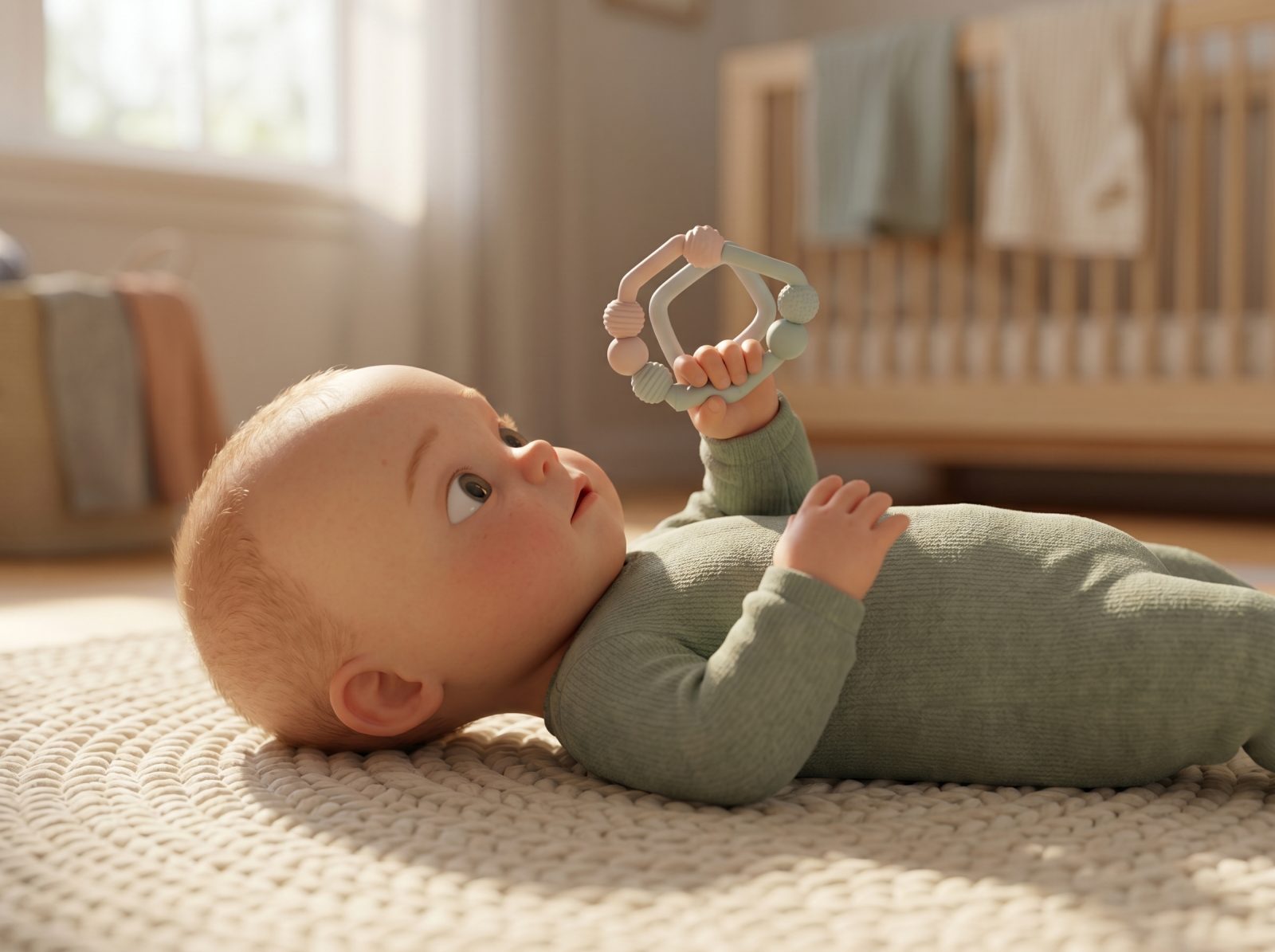
Holds a toy placed in hand
Typical Timing & Development Window
Visual Timeline & Milestone Benchmarks
What these numbers mean
The average age babies first begin showing early signs of this skill. Before this, it's simply too early — there's nothing to worry about.
The midpoint age: half of babies have reached this milestone by here, half a little later. It's a typical target, not a deadline.
How spread out the timing is. About two-thirds of babies achieve it within one standard deviation of the median (the shaded band, wk 14–18). Wide bands mean a normal range of variation.
A gentle check-in point. If your baby hasn't shown this by around here, it can be worth mentioning to your pediatrician — most often it's still perfectly fine, just later.
About this milestone
The infant grips and holds a small, light rattle or toy when it is placed directly into their open hand. This milestone indicates the emergence of a voluntary grasp and early hand-muscle coordination. It allows the infant to begin exploring objects through touch, sight, and eventually taste.
- 1. Place a lightweight, easy-to-grip plastic or fabric rattle into the infant's open palm and gently close their fingers around it.
- 2. Use toys with thin, textured handles that fit perfectly inside a young infant's natural hand grip.
- 3. Gently shake the toy while the infant holds it, helping them connect the physical hand grip with the resulting sound.
- 4. Place a soft wrist rattle on the infant's wrist to encourage them to look at and move their hand.
- 1. Avoid leaving small, hard, or choking-hazard items within the infant's reach while they explore objects.