
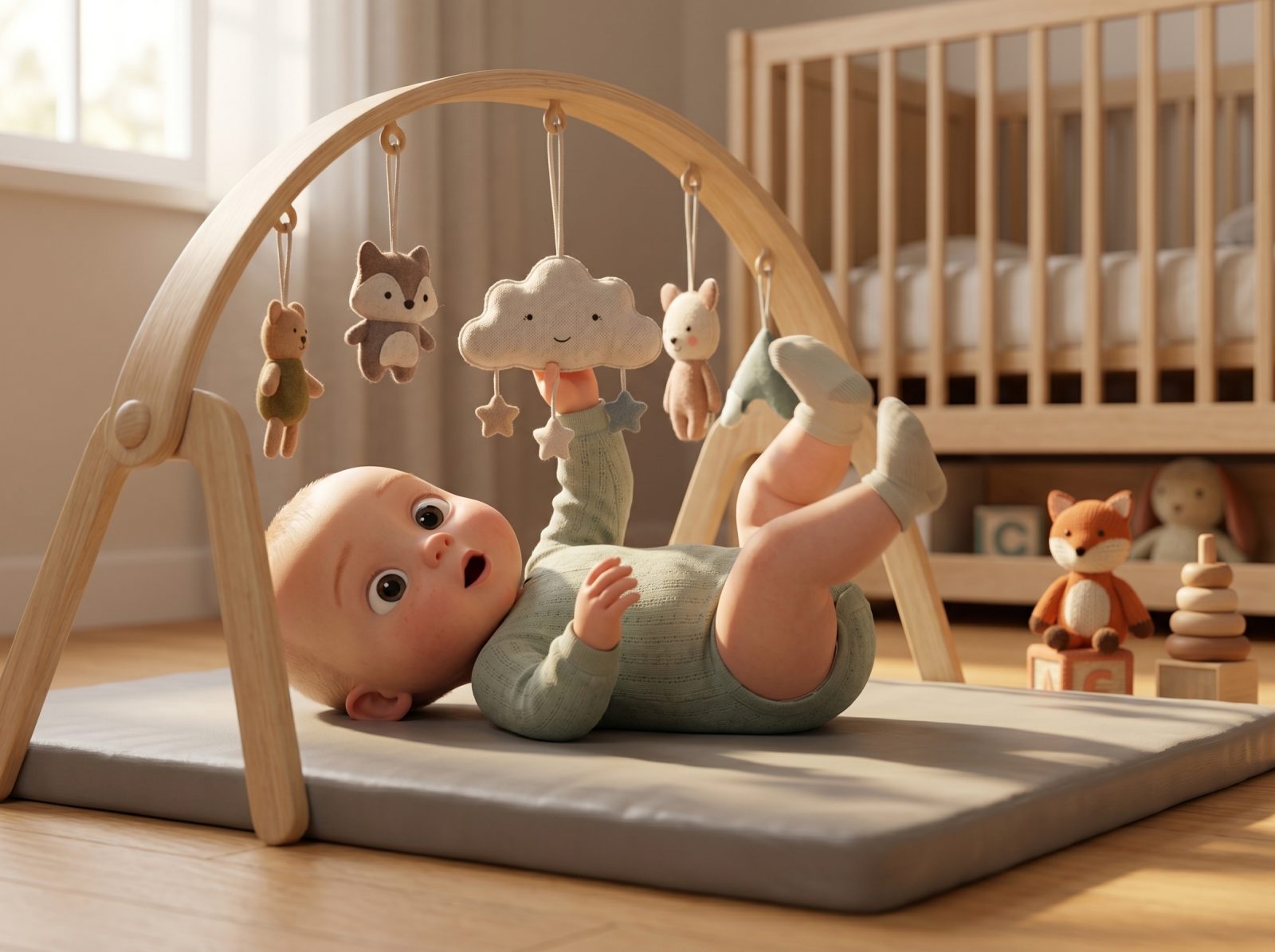
Swings arm to hit toys
Typical Timing & Development Window
Visual Timeline & Milestone Benchmarks
What these numbers mean
The average age babies first begin showing early signs of this skill. Before this, it's simply too early — there's nothing to worry about.
The midpoint age: half of babies have reached this milestone by here, half a little later. It's a typical target, not a deadline.
How spread out the timing is. About two-thirds of babies achieve it within one standard deviation of the median (the shaded band, wk 14–18). Wide bands mean a normal range of variation.
A gentle check-in point. If your baby hasn't shown this by around here, it can be worth mentioning to your pediatrician — most often it's still perfectly fine, just later.
About this milestone
The infant uses their arm to swing at or swipe at dangling toys hanging in front of them. This action demonstrates early visual-motor coordination (hand-eye coordination) and spatial awareness. It is a precursor to purposeful reaching and grasping.
- 1. Place the infant under a stable baby gym with dangling, brightly colored toys positioned within arm's reach.
- 2. Hang soft, musical toys that play a pleasant tone or rattle when swiped, providing immediate cause-and-effect feedback.
- 3. Hold a soft toy 8u201310 inches above the infant's chest while they lie on their back, encouraging them to swipe at it.
- 4. Place wrist rattles on their ankles and wrists to draw attention to limb movements and encourage swatting.
- 1. Avoid dangling toys with long cords or strings that could pose an entanglement risk.