
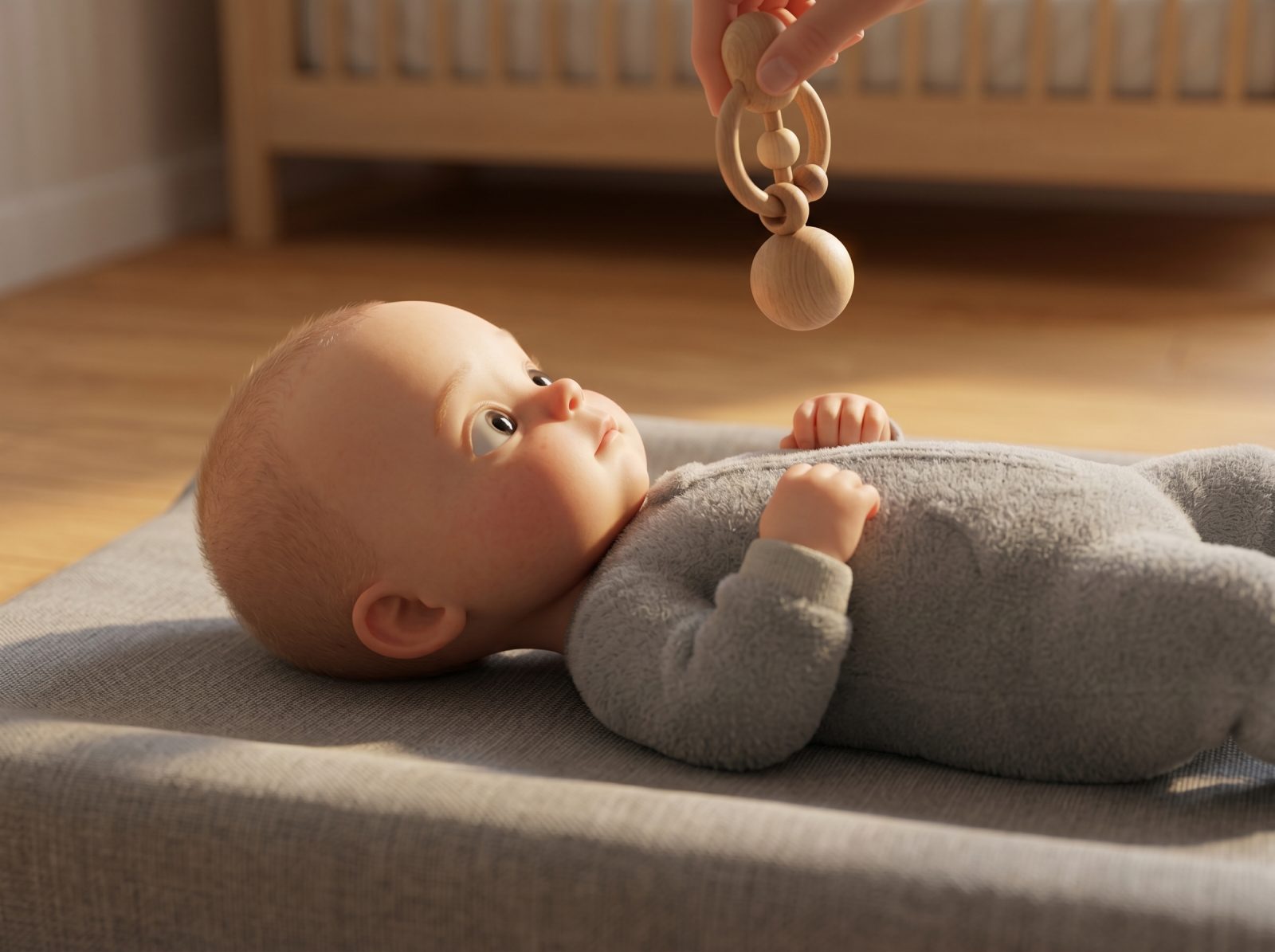
Looks at toy for seconds
Typical Timing & Development Window
Visual Timeline & Milestone Benchmarks
What these numbers mean
The average age babies first begin showing early signs of this skill. Before this, it's simply too early — there's nothing to worry about.
The midpoint age: half of babies have reached this milestone by here, half a little later. It's a typical target, not a deadline.
How spread out the timing is. About two-thirds of babies achieve it within one standard deviation of the median (the shaded band, wk 2–6). Wide bands mean a normal range of variation.
A gentle check-in point. If your baby hasn't shown this by around here, it can be worth mentioning to your pediatrician — most often it's still perfectly fine, just later.
About this milestone
The infant focuses their gaze on a toy or object for several seconds. This action demonstrates early sustained attention, visual curiosity, and cognitive engagement. It shows they are beginning to process details like shape, color, and texture.
- 1. Hold a colorful, high-contrast toy 8u201312 inches in front of the infant's face, keeping it still to let them focus.
- 2. Move the toy slowly from left to right and up and down, watching how they track its movement.
- 3. Provide toys with clear, bold patterns (like black-and-white stripes or concentric circles) that naturally catch their attention.
- 4. Give them plenty of quiet, undistracted time to look at and explore a single toy during playtime.
- 1. Avoid waving the toy rapidly or too close to their face, which can overwhelm them and make it hard to focus.
- 2. Do not constantly switch toys or overstimulate the infant with too many objects at once; let them explore one at a time.
- 3. Avoid using toys with bright, flashing electronic lights, which can cause eye strain and overstimulation.