
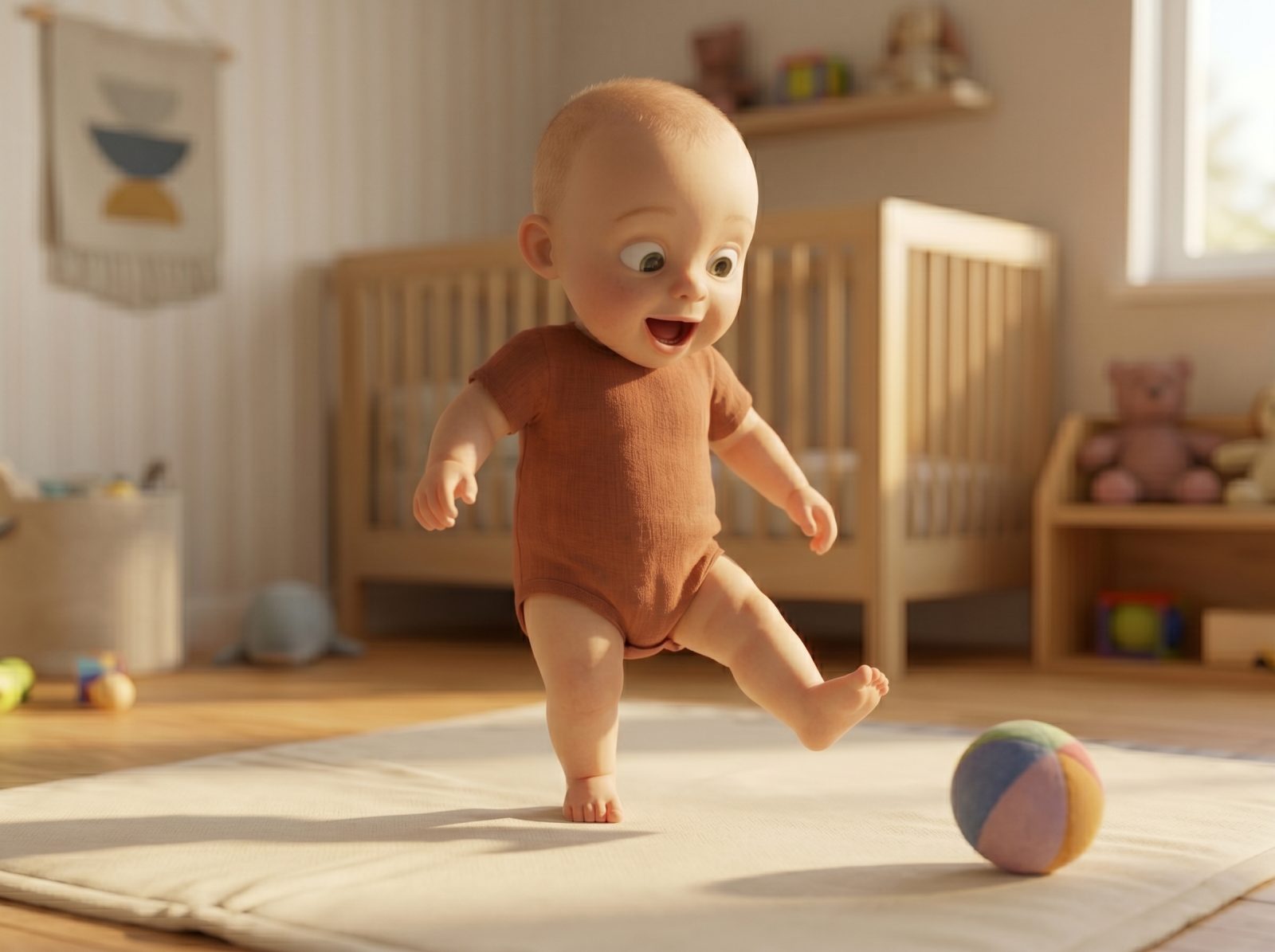
Kicks a ball forward
Typical Timing & Development Window
Visual Timeline & Milestone Benchmarks
What these numbers mean
The average age babies first begin showing early signs of this skill. Before this, it's simply too early — there's nothing to worry about.
The midpoint age: half of babies have reached this milestone by here, half a little later. It's a typical target, not a deadline.
How spread out the timing is. About two-thirds of babies achieve it within one standard deviation of the median (the shaded band, wk 90–102). Wide bands mean a normal range of variation.
A gentle check-in point. If your baby hasn't shown this by around here, it can be worth mentioning to your pediatrician — most often it's still perfectly fine, just later.
About this milestone
The toddler swings one leg forward to kick a stationary ball without losing their balance or holding on to a support. This complex movement requires single-leg standing balance on the supporting limb, visual-motor coordination, and localized muscle strength. It is an indicator of advanced motor planning and equilibrium.
- 1. Place a medium-sized, lightweight, or soft ball (such as an inflatable beach ball) directly in front of the toddler's feet.
- 2. Model the action by kicking the ball yourself, saying 'Kick!' with enthusiasm to encourage them to copy your movement.
- 3. Hold the toddler's hand initially to provide stability as they practice standing on one foot to swing and kick the ball.
- 4. Set up an open 'goal' using two toys, encouraging the toddler to kick the ball through the opening.
- 1. Avoid kicking balls on hard, slippery surfaces where falls can cause injury.
- 2. Do not force the toddler to stand on one leg for extended practice; progress gradually.