
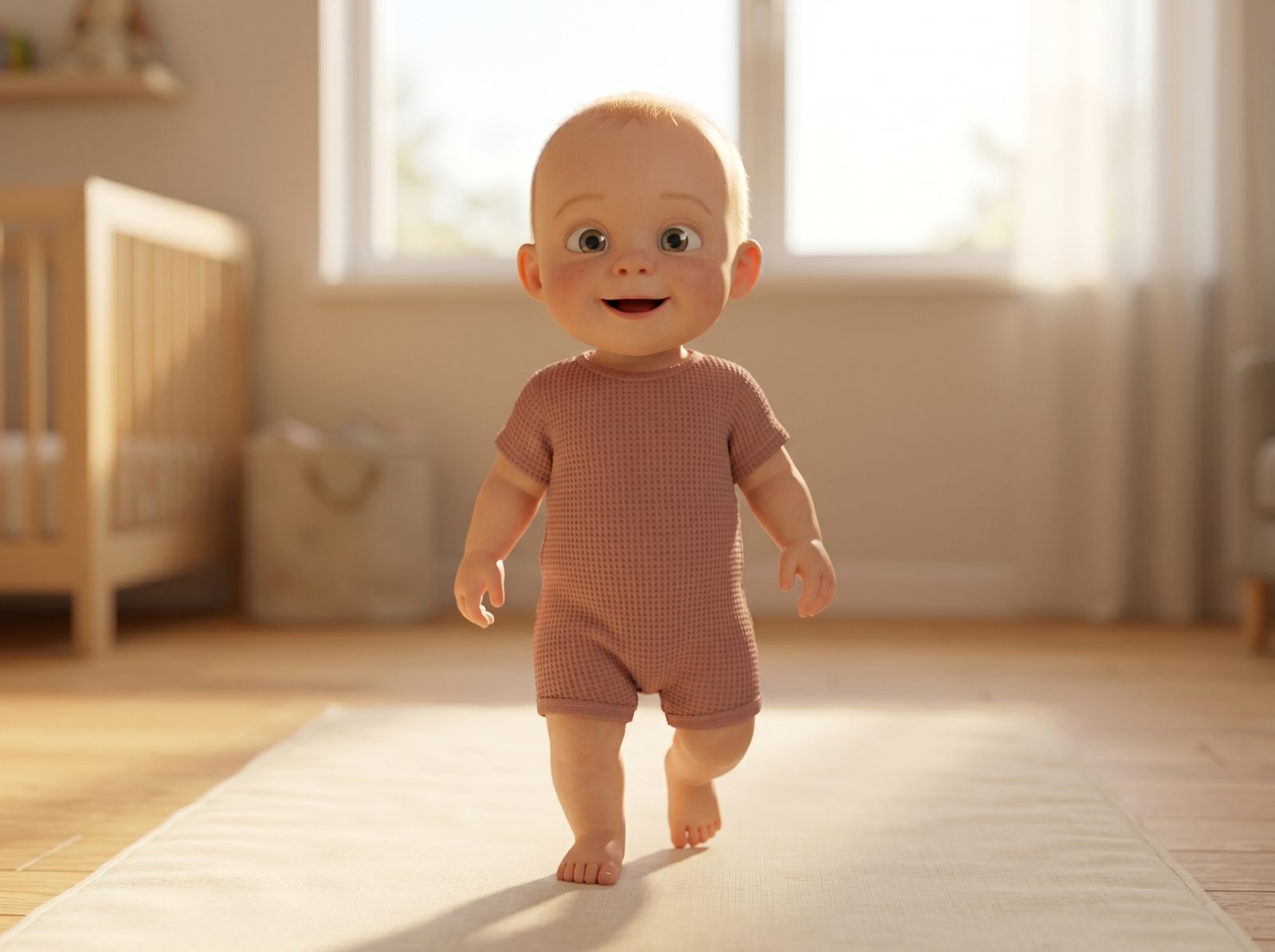
Walks without holding on
Typical Timing & Development Window
Visual Timeline & Milestone Benchmarks
What these numbers mean
The average age babies first begin showing early signs of this skill. Before this, it's simply too early — there's nothing to worry about.
The midpoint age: half of babies have reached this milestone by here, half a little later. It's a typical target, not a deadline.
How spread out the timing is. About two-thirds of babies achieve it within one standard deviation of the median (the shaded band, wk 58–70). Wide bands mean a normal range of variation.
A gentle check-in point. If your baby hasn't shown this by around here, it can be worth mentioning to your pediatrician — most often it's still perfectly fine, just later.
About this milestone
The toddler walks smoothly across a room, maintaining balance, turning corners, and stopping without falling. This indicates the mastery of erect bipedal locomotion, stable hip alignment, and integrated physical balance. Walking independently opens up vast opportunities for environmental interaction and cognitive development.
- 1. Play chasing games like 'tag' or follow-the-leader to practice starting, stopping, turning, and speed variations.
- 2. Give the toddler safe, lightweight objects (like a stuffed animal or empty plastic container) to carry while walking.
- 1. Avoid keeping the toddler buckled in strollers, high chairs, or car seats for long periods when movement is possible.
- 2. Avoid using footwear that is too large or heavy, which can alter their natural gait and lead to frequent tripping.
- 3. Do not worry about occasional flat-footedness or bowing of the legs, which are typical structural variations at this stage.