
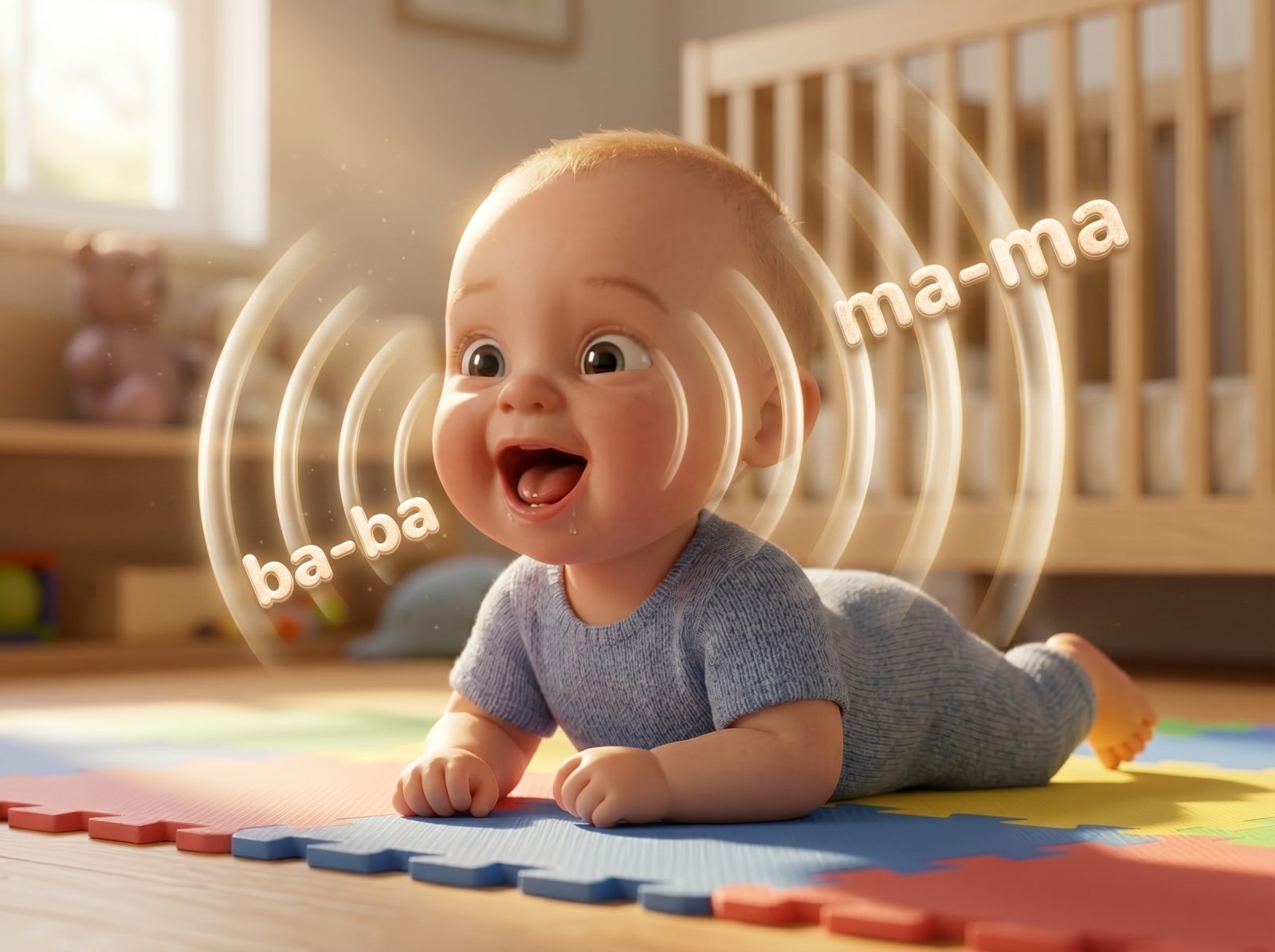
Babbles with consonant sounds
Typical Timing & Development Window
Visual Timeline & Milestone Benchmarks
What these numbers mean
The average age babies first begin showing early signs of this skill. Before this, it's simply too early — there's nothing to worry about.
The midpoint age: half of babies have reached this milestone by here, half a little later. It's a typical target, not a deadline.
How spread out the timing is. About two-thirds of babies achieve it within one standard deviation of the median (the shaded band, wk 26–34). Wide bands mean a normal range of variation.
A gentle check-in point. If your baby hasn't shown this by around here, it can be worth mentioning to your pediatrician — most often it's still perfectly fine, just later.
About this milestone
The infant chains together consonant-vowel combinations like 'ba-ba', 'ma-ma', or 'da-da' (canonical babbling). This indicates the coordination of the lips, tongue, and vocal tract alongside auditory feedback loops. It is the direct physical foundation for producing their first words.
- 1. Imitate and respond to babbling sounds to reinforce vocal experimentation.
- 2. Sing back simple consonant-vowel combinations and pause to give them a turn.
- 3. Read and narrate frequently, giving clear models of sounds and simple words.
- 1. Avoid correcting their babbling or insisting they say words perfectly; babbling is a necessary physical warmup.
- 2. Do not respond to their babbles with silence or indifference; they need feedback to keep practicing.
- 3. Avoid using complicated, long words when simpler, high-frequency words are more helpful for sound practice.