
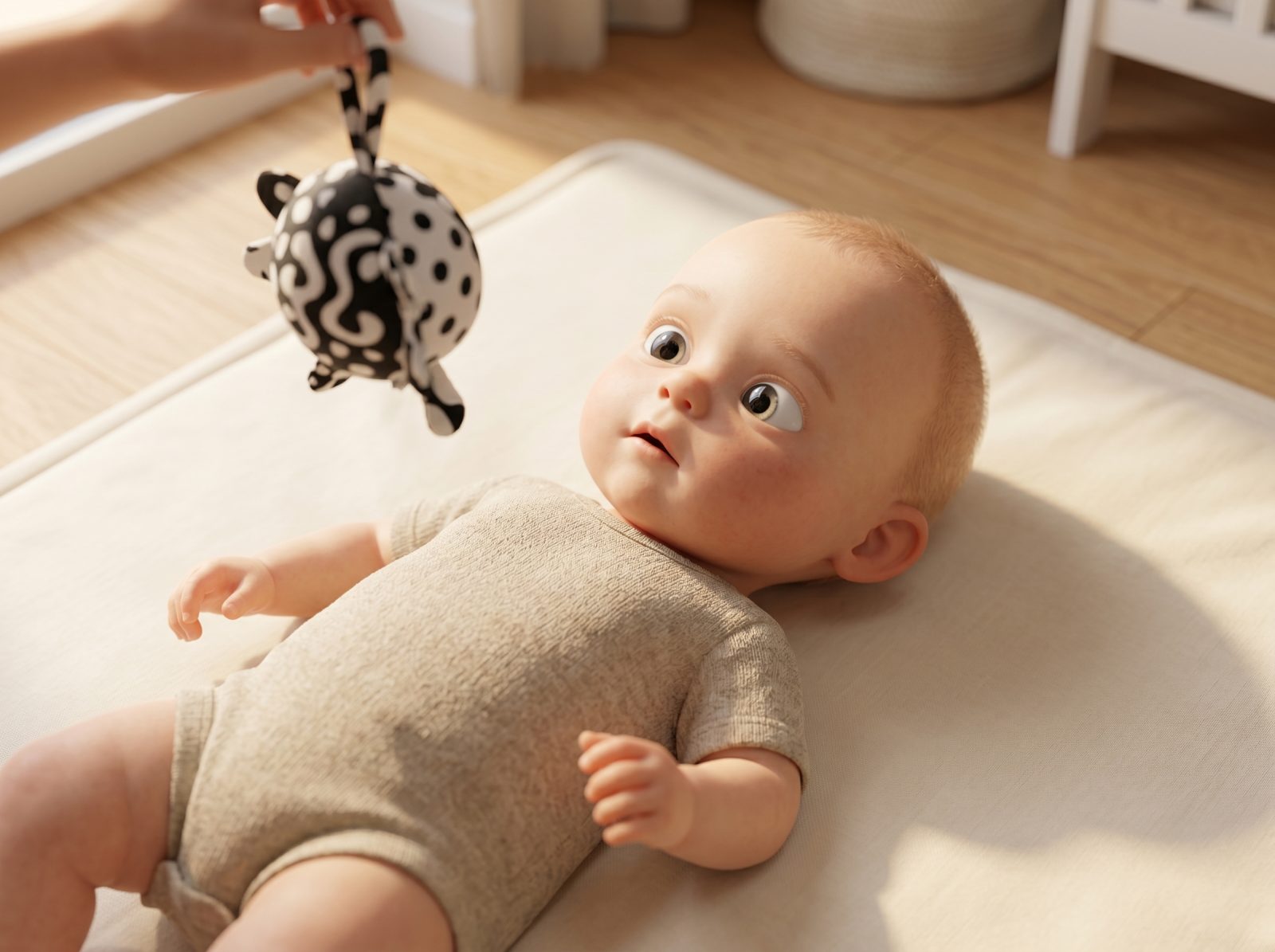
3 Months Cognitive: Visual Tracking
Typical Timing & Development Window
Visual Timeline & Milestone Benchmarks
What these numbers mean
The average age babies first begin showing early signs of this skill. Before this, it's simply too early — there's nothing to worry about.
The midpoint age: half of babies have reached this milestone by here, half a little later. It's a typical target, not a deadline.
How spread out the timing is. About two-thirds of babies achieve it within one standard deviation of the median (the shaded band, wk 10–14). Wide bands mean a normal range of variation.
A gentle check-in point. If your baby hasn't shown this by around here, it can be worth mentioning to your pediatrician — most often it's still perfectly fine, just later.
About this milestone
The infant tracks a slowly moving object back and forth with both eyes. This action confirms healthy binocular vision coordination, visual pursuit, and cognitive focus, serving as the foundational cognitive boundary stone.
- 1. Hold a bright, high-contrast visual object 8–12 inches from your baby's face and move it slowly and smoothly from side to side.
- 2. Engage in close, face-to-face contact, moving your head slowly across their field of vision to prompt direct eye-tracking.
- 3. Position your baby on a flat play mat during active awake times to allow uninhibited neck rotation and visual practice.
- 1. Avoid rapid or erratic toy movements that outpace your baby's emerging visual tracking abilities.
- 2. Avoid using flashing electronic screens or devices, which can cause intense eye strain and overstimulation.
- 3. Do not limit opportunities for visual tracking by keeping your baby continuously confined in passive baby seats or car seats when awake.