Understands the word no
Typical Timing & Development Window
Visual Timeline & Milestone Benchmarks
What these numbers mean
The average age babies first begin showing early signs of this skill. Before this, it's simply too early — there's nothing to worry about.
The midpoint age: half of babies have reached this milestone by here, half a little later. It's a typical target, not a deadline.
How spread out the timing is. About two-thirds of babies achieve it within one standard deviation of the median (the shaded band, wk 40–48). Wide bands mean a normal range of variation.
A gentle check-in point. If your baby hasn't shown this by around here, it can be worth mentioning to your pediatrician — most often it's still perfectly fine, just later.
About this milestone
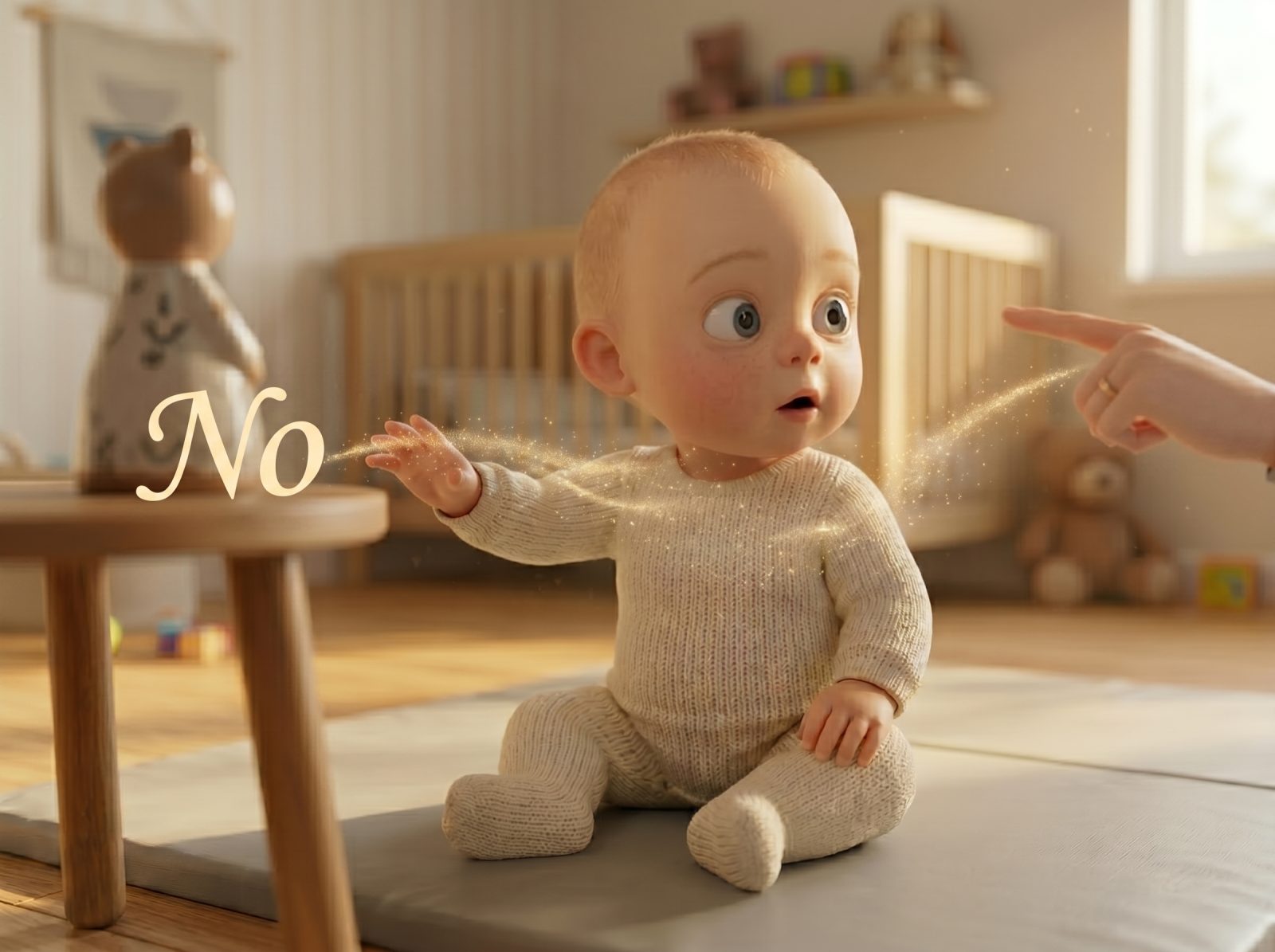
The infant pauses briefly, looks at the caregiver, or stops their current activity when they hear a firm, calm 'no'. This demonstrates emerging receptive language comprehension and the ability to process verbal boundaries. It is a critical early milestone for safety and behavior guidance.
- 1. Use 'no' sparingly, reserving it for dangerous situations (like touching a hot stove or pulling a pet's tail) to keep it effective.
- 2. Say 'no' in a firm, calm, and low voice, accompanied by a serious facial expression and a gentle hand signal.
- 3. Redirect the infant immediately to a safe, alternative activity after saying 'no' ('No touching the plant. Here is your ball.').
- 4. Praise the infant warmly ('Thank you for stopping!') when they pause or stop in response to your boundary.
- 1. Avoid yelling, screaming, or spanking when saying 'no', as this causes fear and raises stress without teaching safe boundaries.
- 2. Avoid using long, complicated explanations that are too complex for an infant's receptive language skills.
- 3. Do not laugh or smile when saying 'no', as mixed signals confuse the infant about your expectations.