
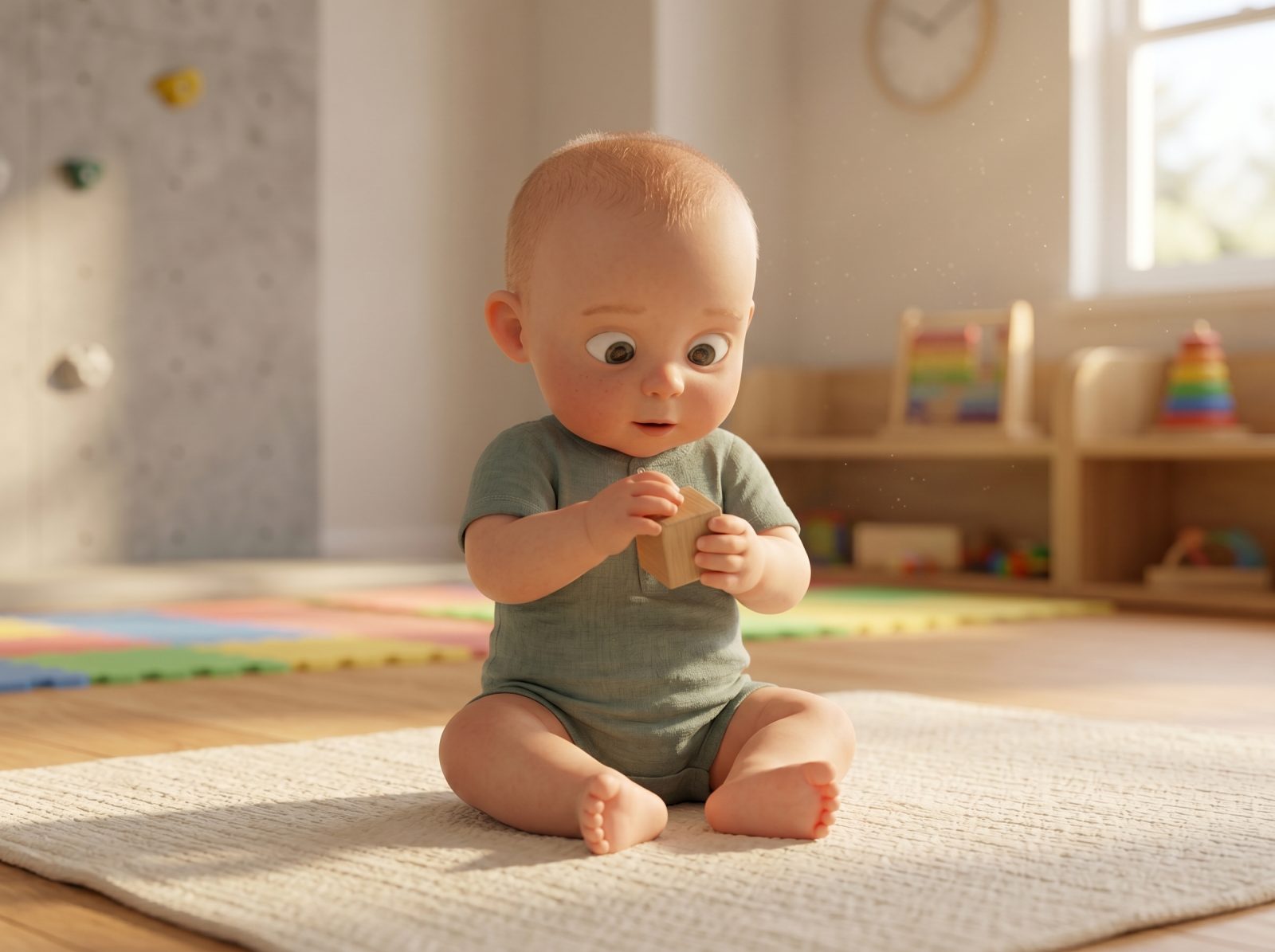
Transfers objects between hands
Typical Timing & Development Window
Visual Timeline & Milestone Benchmarks
What these numbers mean
The average age babies first begin showing early signs of this skill. Before this, it's simply too early — there's nothing to worry about.
The midpoint age: half of babies have reached this milestone by here, half a little later. It's a typical target, not a deadline.
How spread out the timing is. About two-thirds of babies achieve it within one standard deviation of the median (the shaded band, wk 27–33). Wide bands mean a normal range of variation.
A gentle check-in point. If your baby hasn't shown this by around here, it can be worth mentioning to your pediatrician — most often it's still perfectly fine, just later.
About this milestone
The infant moves a toy or object from one hand to the other. This skill requires bilateral coordination (the ability to use both sides of the body together) and the integration of the left and right brain hemispheres. It is a critical milestone for developing hand dominance and complex object manipulation.
- 1. Offer the infant a small toy in one hand, then present a second toy to the same hand, encouraging them to transfer the first toy to free up space.
- 2. Offer toys with central handles, such as plastic keys on a ring, which naturally facilitate hand-to-hand hand-offs.
- 3. Play 'pass the toy' games, modeling the transfer of an object between your own hands and encouraging them to copy.
- 4. Provide small, safe kitchen items, like a plastic measuring cup, to play with during high-chair time.
- 1. Avoid using objects with detachable small parts that present choking hazards.