
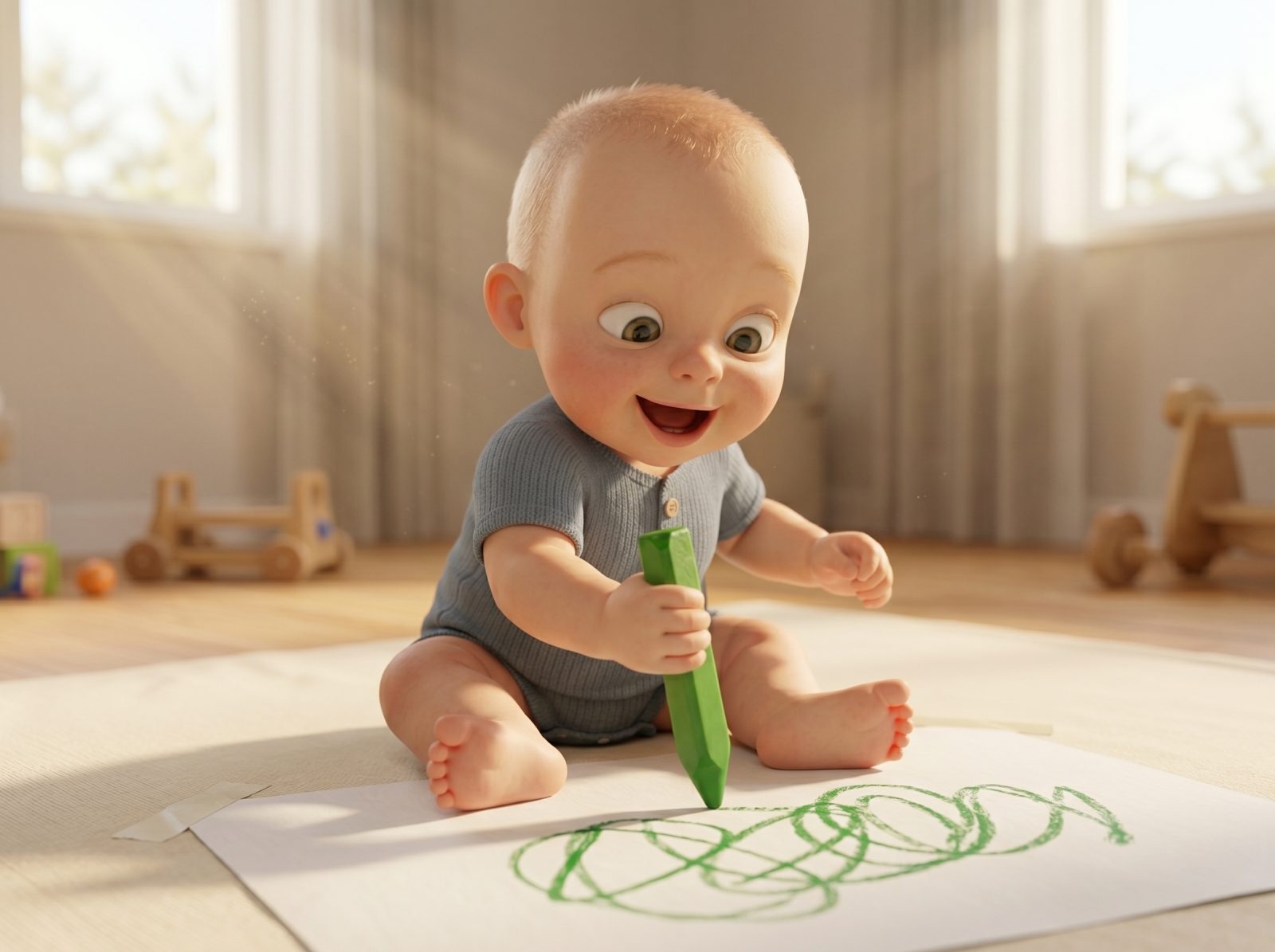
Scribbles with a crayon
Typical Timing & Development Window
Visual Timeline & Milestone Benchmarks
What these numbers mean
The average age babies first begin showing early signs of this skill. Before this, it's simply too early — there's nothing to worry about.
The midpoint age: half of babies have reached this milestone by here, half a little later. It's a typical target, not a deadline.
How spread out the timing is. About two-thirds of babies achieve it within one standard deviation of the median (the shaded band, wk 65–75). Wide bands mean a normal range of variation.
A gentle check-in point. If your baby hasn't shown this by around here, it can be worth mentioning to your pediatrician — most often it's still perfectly fine, just later.
About this milestone
The toddler holds a thick crayon or marker in a fist or palm grasp and makes voluntary marks on paper. This indicates emerging wrist control, shoulder-arm coordination, and visual-motor integration. It is the fundamental foundation for writing and drawing.
- 1. Provide thick, easy-to-grip triangular crayons or egg-shaped chalk designed for a toddler's hand.
- 2. Sit next to the toddler and draw lines or circles, encouraging them to copy your physical arm movements.
- 3. Let them draw using finger paints or shaving cream on a tray to build arm-and-hand coordination.
- 1. Avoid correcting their hand grip to a 'pencil grip'; a palm-down fist grasp is developmentally normal and necessary at this age.
- 2. Do not use thin, easily breakable crayons that can break and cause frustration.
- 3. Avoid using markers or paints that are not labeled as non-toxic and washable.