
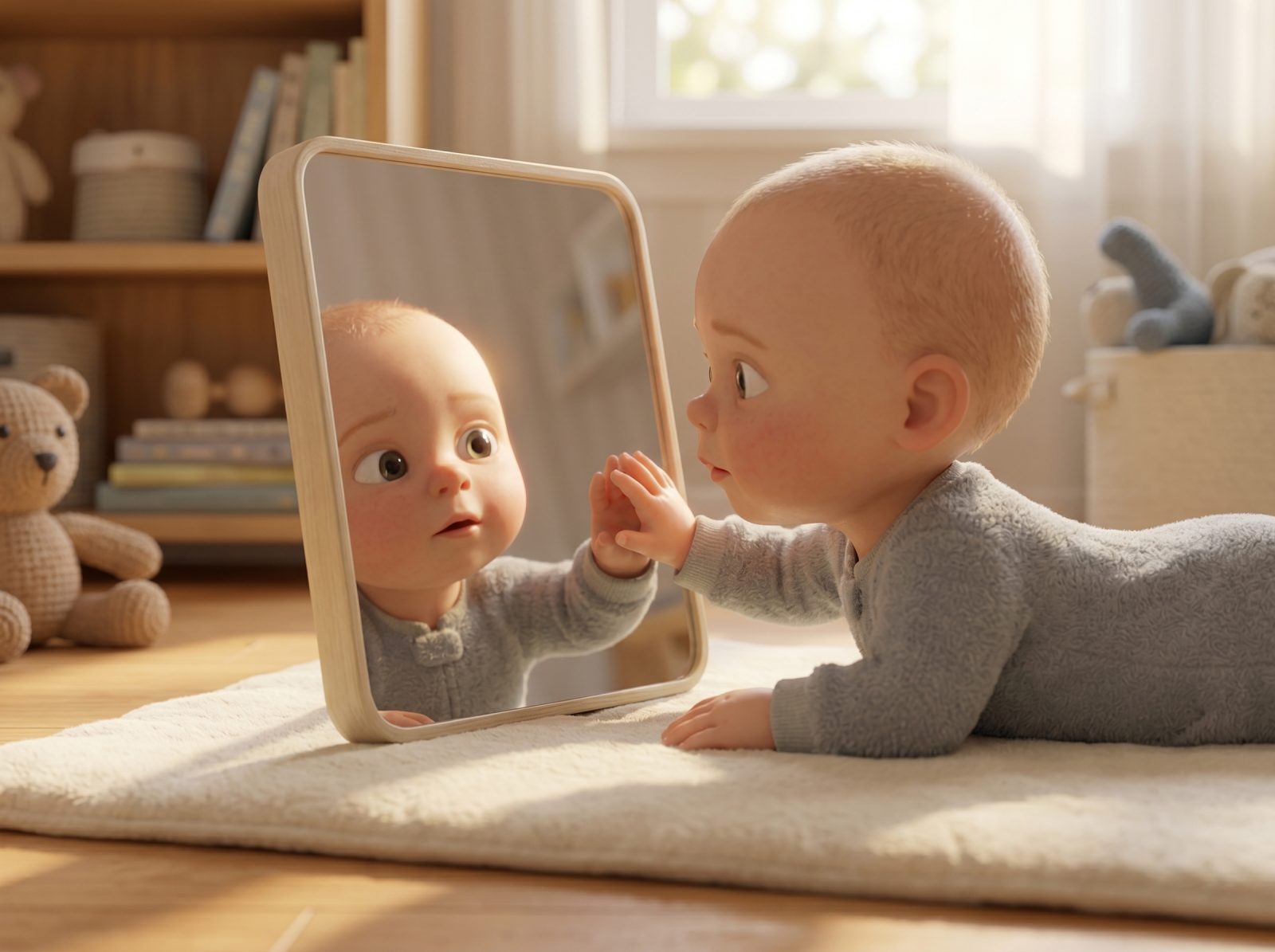
Looks at self in mirror
Typical Timing & Development Window
Visual Timeline & Milestone Benchmarks
What these numbers mean
The average age babies first begin showing early signs of this skill. Before this, it's simply too early — there's nothing to worry about.
The midpoint age: half of babies have reached this milestone by here, half a little later. It's a typical target, not a deadline.
How spread out the timing is. About two-thirds of babies achieve it within one standard deviation of the median (the shaded band, wk 21–27). Wide bands mean a normal range of variation.
A gentle check-in point. If your baby hasn't shown this by around here, it can be worth mentioning to your pediatrician — most often it's still perfectly fine, just later.
About this milestone
The infant looks at their own reflection in a mirror with interest, often smiling, cooing, or reaching out to touch it. This milestone is an early step in developing self-awareness, visual processing, and social mirroring. It shows they are intrigued by human features and movement.
- 1. Sit with the infant in front of a large mirror, pointing to their reflection and saying, 'Look, there's you!'.
- 2. Make funny faces in the mirror together, blinking your eyes or waving your hand to show movement.
- 3. Gently touch the infant's nose or hand while they look in the mirror to help them connect touch with what they see.
- 1. Avoid using glass mirrors that are not labeled as shatterproof and baby-safe, which can pose a safety risk.
- 2. Do not leave the infant alone with an unsecured or heavy mirror that could tip over and cause injury.
- 3. Avoid using dusty or distorted mirrors that make it difficult for the infant to see their reflection clearly.