
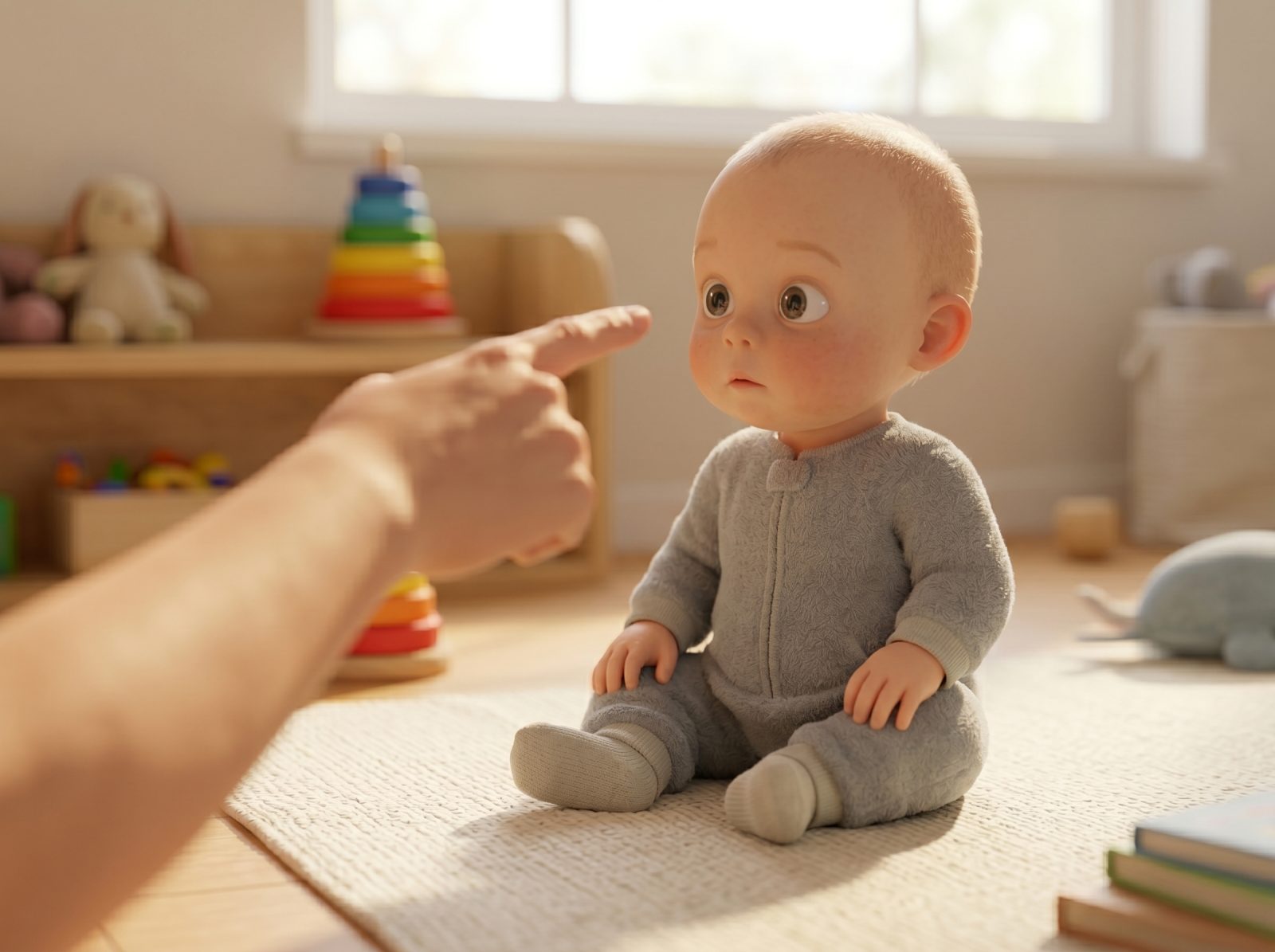
Executes gaze following (Visual Joint Attention)
Typical Timing & Development Window
Visual Timeline & Milestone Benchmarks
What these numbers mean
The average age babies first begin showing early signs of this skill. Before this, it's simply too early — there's nothing to worry about.
The midpoint age: half of babies have reached this milestone by here, half a little later. It's a typical target, not a deadline.
How spread out the timing is. About two-thirds of babies achieve it within one standard deviation of the median (the shaded band, wk 37–43). Wide bands mean a normal range of variation.
A gentle check-in point. If your baby hasn't shown this by around here, it can be worth mentioning to your pediatrician — most often it's still perfectly fine, just later.
About this milestone
The infant looks in the exact direction a caregiver is looking when the caregiver turns their head to look at something interesting. This indicates an understanding that eyes hold data and intention, which is critical for social learning.
- 1. Turn your head dramatically toward an object and say, 'Look at that!' to draw the infantu2019s line of sight.
- 2. Point directly at items while making eye contact with the infant, ensuring they map the trajectory of your gaze.
- 3. Play tracking games where you visually look toward a favorite toy when it makes a sound.
- 1. Avoid trying to catch their attention from deep across a cluttered room; practice face-to-face first.
- 2. Do not assume a lack of response is intentional; young infants require a clean, distraction-free environment to map gaze lines.