
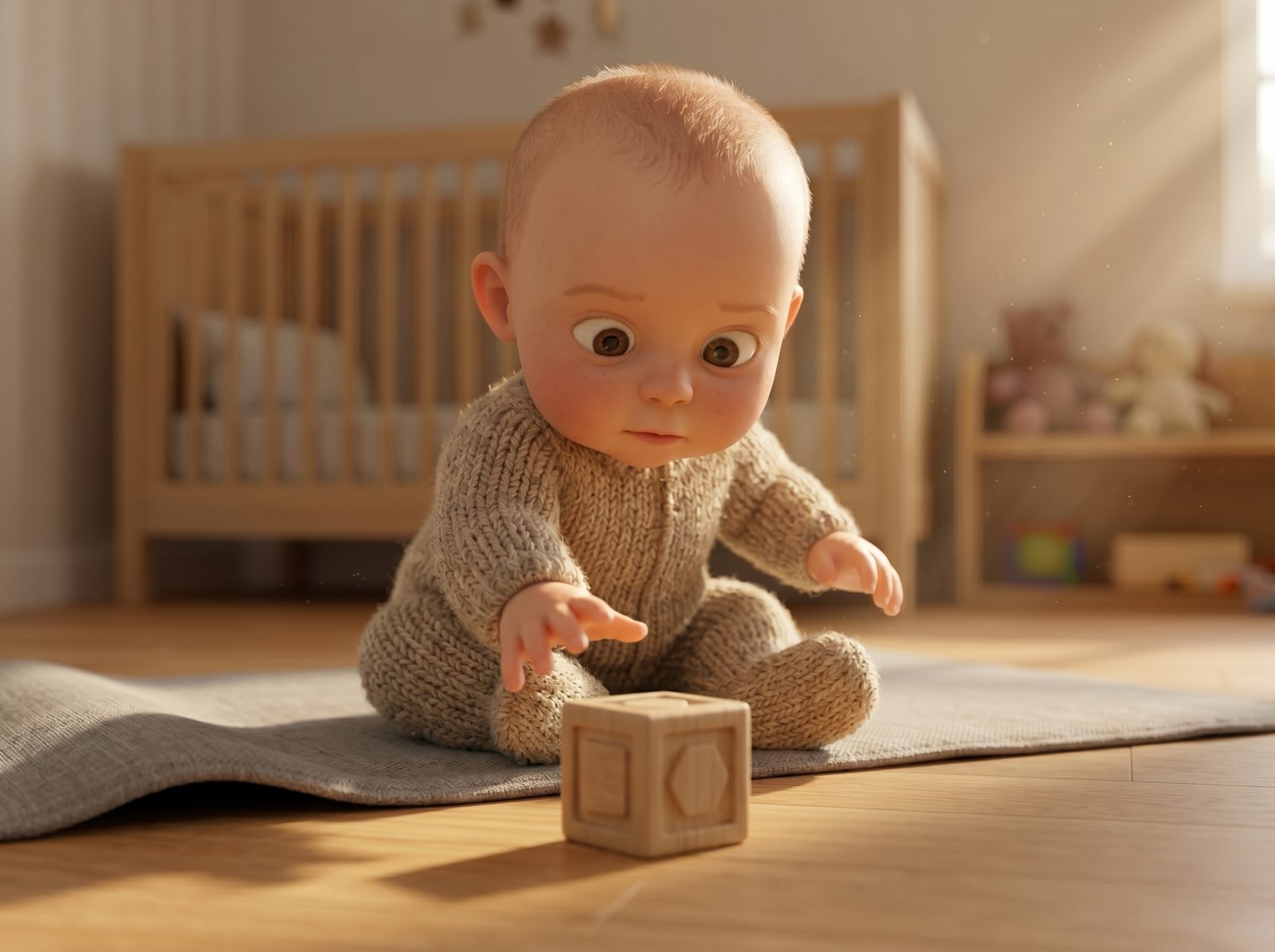
Demonstrates mature binocular depth perception
Typical Timing & Development Window
Visual Timeline & Milestone Benchmarks
What these numbers mean
The average age babies first begin showing early signs of this skill. Before this, it's simply too early — there's nothing to worry about.
The midpoint age: half of babies have reached this milestone by here, half a little later. It's a typical target, not a deadline.
How spread out the timing is. About two-thirds of babies achieve it within one standard deviation of the median (the shaded band, wk 21–27). Wide bands mean a normal range of variation.
A gentle check-in point. If your baby hasn't shown this by around here, it can be worth mentioning to your pediatrician — most often it's still perfectly fine, just later.
About this milestone
The infant achieves full coordinate control of binocular tracking and stereoscopic vision, allowing them to judge three-dimensional distances and perceive sudden drops or height variations.
- 1. Provide safe, low floor-level changes (e.g., firm foam climbing blocks) to let them visually judge height variations.
- 2. Roll small balls across their field of vision, prompting them to reach out and stop them accurately mid-motion.
- 3. Allow open floor exploration so they can safely navigate around obstacles and furniture boundaries.
- 1. Avoid leaving changing tables or elevated platforms unmonitored; infants may misjudge the edge drop during early integration.
- 2. Do not block off all structural variations; controlled tracking experiences are critical to fine-tuning depth calculations.